The Difference Between Watching and Being Watched
A lot of people buy a tank monitor and use it mainly to check levels when they think to — a bit like checking your phone for messages rather than setting it up to notify you. That works as far as it goes, but it is not really using the technology for what it is good at. The real value of a remote tank monitor is not giving you a number to look at when you are already wondering about it. It is telling you about a problem before you would otherwise know it exists.
The difference between a level that is dropping normally and one that is dropping because of a leak or a failed pump is often only visible over a 6 to 12-hour period. If you check your app once a day you might catch it. If you check every few days — which is the reality on a busy property — you could have cattle without water for 24 hours before you know anything is wrong. Properly configured alerts fix that.
The one Alert Every Tank Should Have
The first and most obvious alert is a low level warning. This should be set at a level that gives you enough time to respond — and that means thinking through what response time looks like for your property. If your tanks are an hour away from the homestead and you have a full-time job off-farm on certain days, your low-level alert needs to trigger as soon as possible to allow you time to respond. For most livestock situations, an alert at 25 to 30 per cent of tank capacity is a reasonable starting point, but adjust it upward or add a second alert if your response time is long or your stock pressure is high.
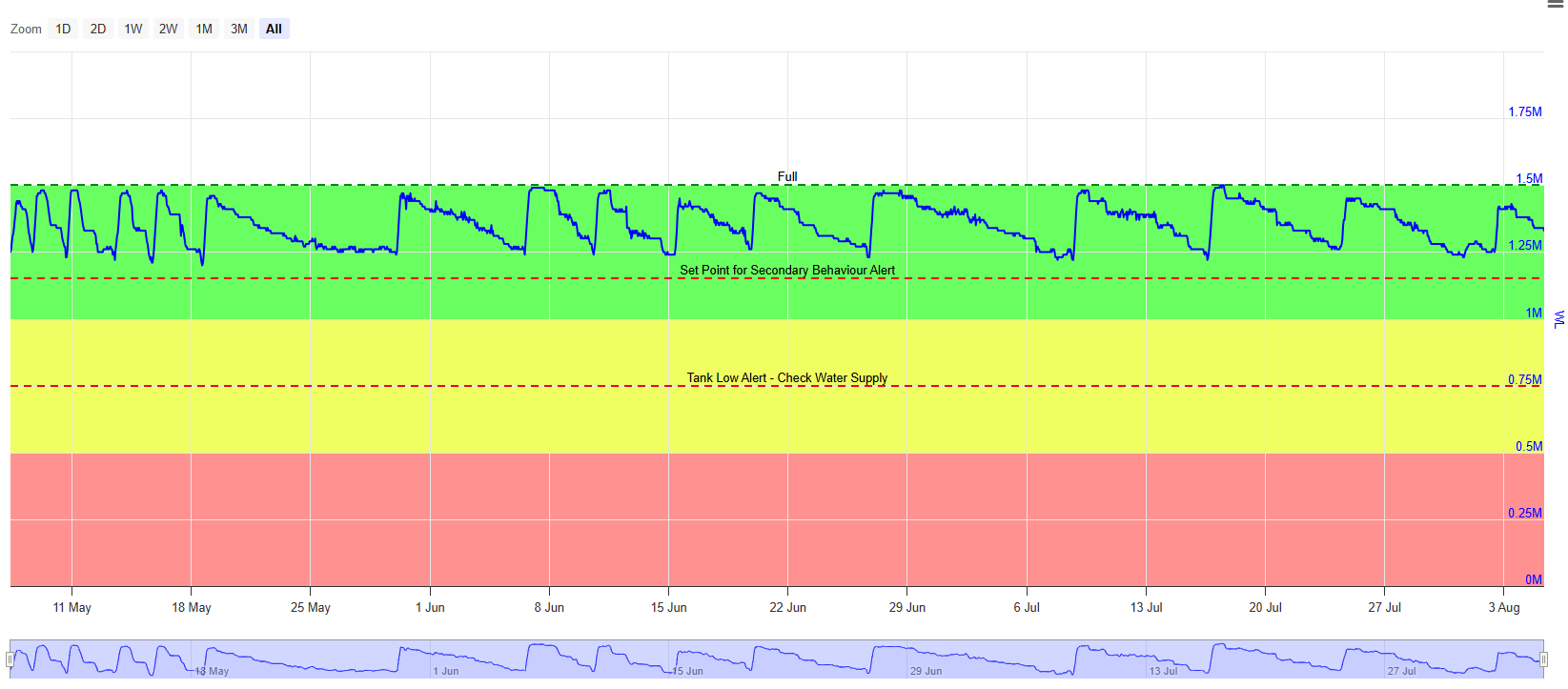
The second alert is one many people overlook: An abnormal alert as oppased to "the water is nearly gone" alert. After ony a couple weeks of operation, your tank monitor will show the behaviour of the water level in the tank. Consider setting an alert just under the normal lowest reading you see on the tank. This does a couple of things. Firstly, it alerts to an abnormal event that doesnt necessarily mean there is a broken pipe or pump. It alerts you to behaviour your water system is experiencing that may need attention one day, not necessarily today. Many customers report one of the largest unexpected benefits tank monitors show them is how their water system behaves. Its strengths and weaknesses. About half of users report things like the tank monitors show them how their water system is behaving that leads to future upgrades or changes to how their water system is designed. This is different to "I need to do something today", rather its a property development or set-up thing in a longer term plan.
Sizing Your Alert Thresholds to Your Stock Numbers
It's a simple thing - more stock drink more water. As stock are moved around the demands on a water supply for a paddock changes, and so too should the tank levels you use for alerts. the above chart shows a regular pattern created by water use the stock require. Double the stock numbers, the pattern changes. Alerts can and are a dynamic thing and changing them when you need to yields a better, more accurate and useful alerting result.
Detecting Leaks With a Flow Pattern Alert
Leaks in rural water systems are common and often go undetected for weeks. A small leak in a pipeline — a cracked fitting, a damaged float valve, a corroded joint — might only lose a few hundred litres per day, which is easy to miss if you are not looking for it. Over a month that adds up to several thousand litres, and in a drought that is real money and real animal welfare risk.
The most reliable way to catch a slow leak with a tank monitor is to track overnight consumption. Animals do not generally drink at night. If your tank is consistently dropping by 300 to 500 litres between 10pm and 6am when no stock are drinking, and that was not happening previously, you may have a leak somewhere in the system. Set a baseline for your typical overnight drop rate — note it in your monitoring platform or keep a written record — and treat any consistent deviation from that baseline as a sign to investigate.
For pipelines feeding multiple tanks, a sudden unexplained drop in just one tank on the network is often the first sign of a localised leak. Your monitoring data effectively functions as a leak detection tool at no extra cost once the sensors are in place.
Another tool to see leaks very clearly is to use a water meter to capture the flow rate feeding tanks or troughs. This is called a leak detector. See more info about Leak Detectors here.
Setting Up Alerts in the BushLinx® Platform
In BushLinx®, tank level alerts are set per tank level sensor and can be configured for high level or low level thresholds. You can choose to receive notifications by SMS, email, or both, and you can set different alert recipients each tank — useful if you want alerts to go to a farm manager or the person looking after the water runs. You also set a time to reactivate the alert - because data streams in regularly we use a reactivation time so that the alert doesnt trigger every time new data lands. You choose how often you receive an alert for the wame thing.
Once configured, the system monitors levels continuously and sends the alert as soon as the threshold is crossed. You do not need to be in the app. You do not need to be thinking about it. That is the whole point — it watches so you do not have to, and it talks to you when something actually needs your attention.
Monitor your tanks from anywhere
BushLinx® tank monitors give you real-time levels, SMS alerts, and rate-of-change detection — so you know about a problem long before your stock do.
See Tank Monitors → Talk to Tim